
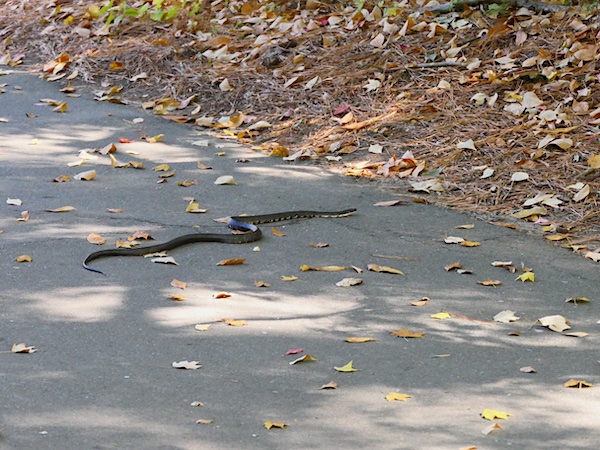
Top Photo: Rat snake heading towards the woods.
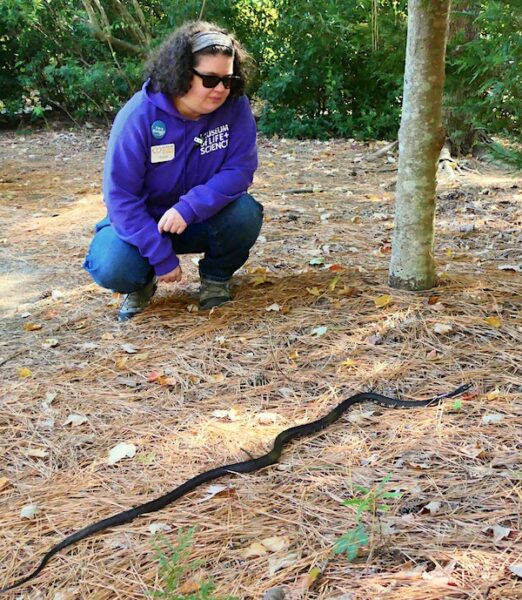
Ranger Alyssa spotted a black snake making its way quietly across the pine straw and leaf litter at the Sailboat Pond in Catch the Wind. The nearly all black snake looked to be over five feet. It was a rat snake. Rat snakes regularly grow to 6 feet. The maximum on record is about 8.5 feet.
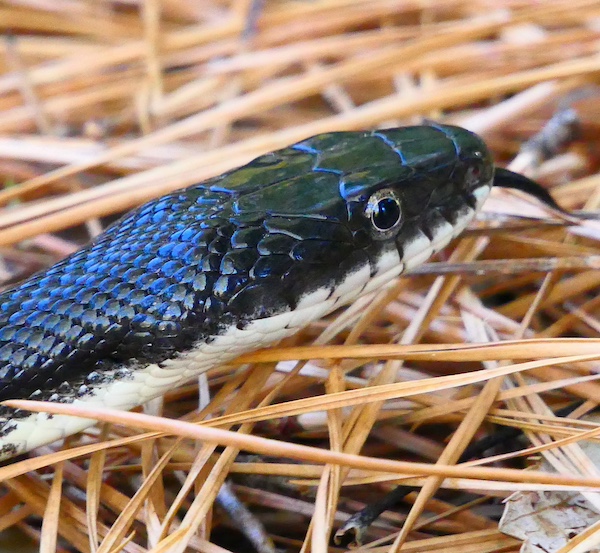
Rat snakes (Pantherophis alleghaniensis), here on the Piedmont, are typically all black except for a white venter (which may be checkered), chin and throat. On the coastal plain they’re yellow-green with four dark stripes running the length of the body.
These snakes are looked upon favorably by home owners and farmers for their fondness for grain-eating rodents like mice and rats. But anyone who has seen them crawling around the branches of springtime trees hunting for nestling birds or eggs or in their chicken coops gulping down their free-range chicken eggs, or worse yet, in their bluebird nest boxes, may have trouble forgiving the snakes for their behavior. But they are much more beneficial than destructive.
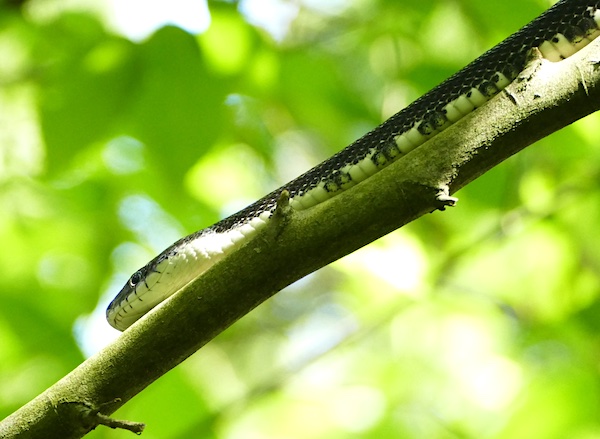
They’re found state wide, are excellent climbers, and move around the landscape as if time was on their side. They’re oviparous, laying anywhere from 5 to 30 eggs in a moist, hidden location. I’ve heard of several instances of eggs being deposited in compost piles. Hatchlings are about a foot long and are heavily patterned.
Another rather long black snake found in our area is the black racer. They have a different body shape, lack keels on their scales, and are black throughout, except for a bit of white on their chin and in some cases, throat (compare the two snakes here), and are much more swift in their movements.
Ranger Alyssa watched the snake until it was safely across the path. The snake was probably heading for its winter quarters under a boulder or the remains of an old concrete structure not 30 feet away in the woods. The weather is turning and we may not see this snake again until spring.
Ranger Greg