
Top Photo: Palamedes swallowtail explores redbay leaves at Museum of Life and Science.
Thanks to Richard Stickney, known by most regulars at the Museum of Life and Science as the Lead Conservatory Specialist at the very popular Butterfly House, I got to see an unusual sight here at the museum on the 18th of April. In fact, Richard hadn’t seen another one here since July 14 of 2021 (another sighting was on 16 May, 2010 by a local naturalist at Eno River Park here within the City of Durham – there was one in Orange County in both 2022 and 2024).
Why is this noteworthy? The butterfly is essentially a Coastal Plain butterfly. They’re listed as “abundant” in many locations east of us on the Coastal Plain and “common” elsewhere there. This is according to the Butterflies of North Carolina: their Distribution and Abundance website.
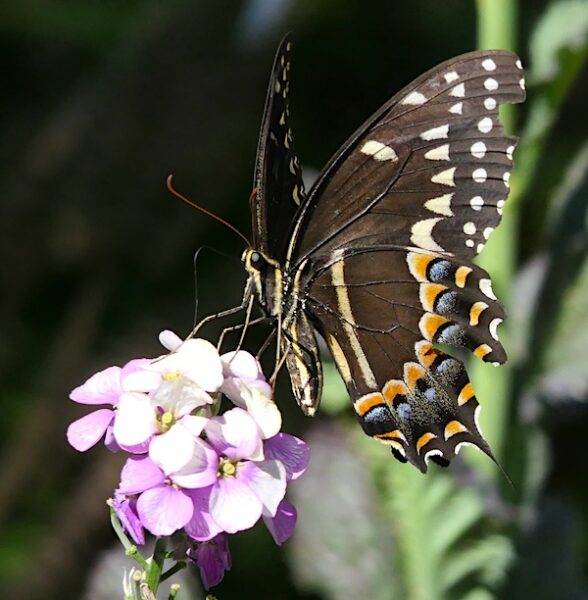
The butterfly seen here was investigating the leaves of a redbay tree and may have oviposited on some of the leaves. The redbay is their chief food or host plant on the Coastal Plain. The redbay here is at the top of the stairs leading to the Butterfly House. We’re going to keep an eye on the tree’s leaves in the next few weeks or so for signs of chewing. The tree was planted here, is a healthy individual, and is cared for by the crew at the Butterfly House. The butterfly was also nectaring on flowers in the garden next to the tree.
How do you know if what you’re looking at is a Palamedes swallowtail and not one of the other, much more common, large black swallowtails in the area? The Palamedes may look quite brown in good light or when faded by wear. It has a yellow stripe across the under surface of its hindwings. It also has yellow stripes on its abdomen. Most other black swallowtails have spots on their abdomens and lack the yellow stripes.
The Palamedes swallowtail is named for the Trojan War hero Palamedes, “Most Clever Greek.” He was an intellectual, but apparently not smart or clever enough to avoid being framed and killed by Odysseus.
Many of the swallowtail butterflies are named for Greek, Trojan War heroes.
Keep a sharp lookout, you never know what will show up!
Ranger Greg