
Top Photo: Elephant mosquito nectaring on mums.
Lead Conservatory Specialist Richard Stickney was leaning over the railing, cell phone at the end of his outstretched arms. He looked to be concentrating on a group of yellow flowers (chrysanthemums) just off the path in the Butterfly House Garden. When you see Richard focused as he was, there is most likely something interesting at the focal point. I walked over to see what it was.
Richard had spotted a mosquito. It’s November and mosquitos are not supposed to be in flight. Interesting enough, but being active in November is far from the most interesting thing about this mosquito. It was nectaring on flowers, the mums. Most mosquitos, as nearly the entire planet’s human population knows all too well, poke holes in animal’s skin and suck their blood, including us humans. This mosquito takes nectar from flowers and other sweet liquids like honeydew (the waste product of aphids and psyllids) and fruit. It does not suck blood.
This insect, and the object of Richard’s attention, was an elephant mosquito. Most elephant mosquitos reside in tropical settings, this one (Toxorhynchites rutilus) is found in the southeastern United States, New England, west to Oklahoma and south.
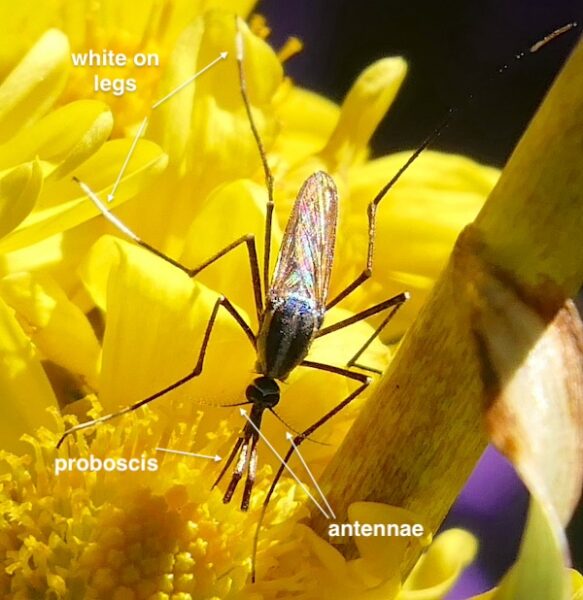
It’s large too, about 18mm body length (not including legs) for the elephant and 5mm for the “normal-sized” Asian tiger mosquito. The name elephant supposedly comes from the fact the insect is so large, for a mosquito, that is. But I’ve read that the name may also derive from the males’s upturned palps which resemble the long tusks of male African elephants. Or, the down curved proboscis of both sexes reminding others of an elephant’s trunk.
But the most interesting fact concerning the big fly is that it does not tap into us. And, the larvae of the mosquito eats, that’s right, eats, other less desirable mosquito larvae, like the above mentioned Asian tiger mosquito.
One of the downfalls is the mosquito doesn’t necessarily share the same water habitats as most other mosquitos. It shuns ponds and lakes for small intimate little puddles, like an abandoned tire and holes in tree trunks, hence the alternate common name of treehole predatory mosquito.
Males can easily be told from female by their bushy or feathery antennae.
Don’t confuse the mosquito for a crane fly, some species of which resemble a mosquito, though usually larger.
So, there you have it. You never know what’ll show up in your own backyard!
Ranger Greg