
Top Photo: Tiny monarch caterpillar (1st instar) feeds on milkweed.
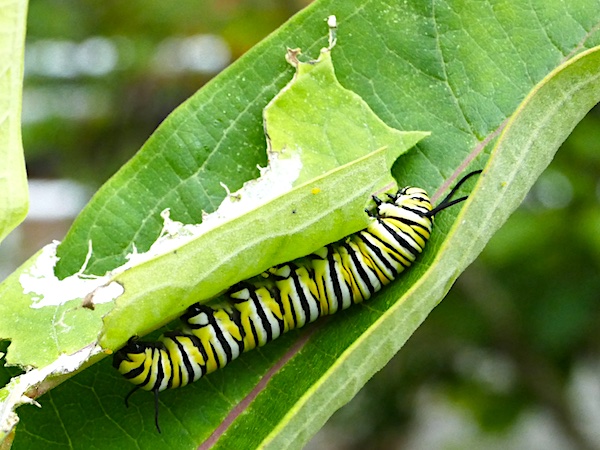
At hatching, monarch butterfly larvae are small, about 2 – 5 mm small. They molt four times during their caterpillar phase (five instars) growing larger each time.
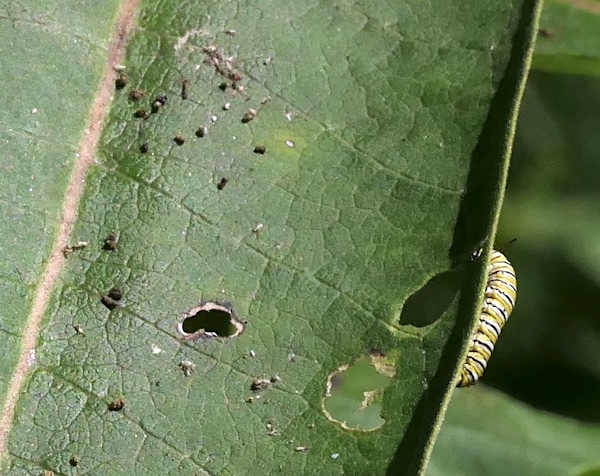
The larva in this post, since being photographed, has disappeared. If it made it through the caterpillar stage it would be a chrysalis or perhaps an adult butterfly by now. I looked over the milkweed the original adult oviposited on, and the caterpillar subsequently fed on, but could not locate it. The caterpillars often crawl down the stem of the plant they’re consuming and find a suitable location to pupate elsewhere. I’m hoping that’s what occurred here and the adult butterfly is now on the way to Mexico.
I often mention green tree frogs on this blog. The little froglets are hard to resist as they morph from tadpole to frog. Every trip I make out on the Floating Walkway in our wetlands brings the discovery of from one to half a dozen of the tiny green amphibians. Yesterday I saw an odd colored one. It was silvery blue on its back.
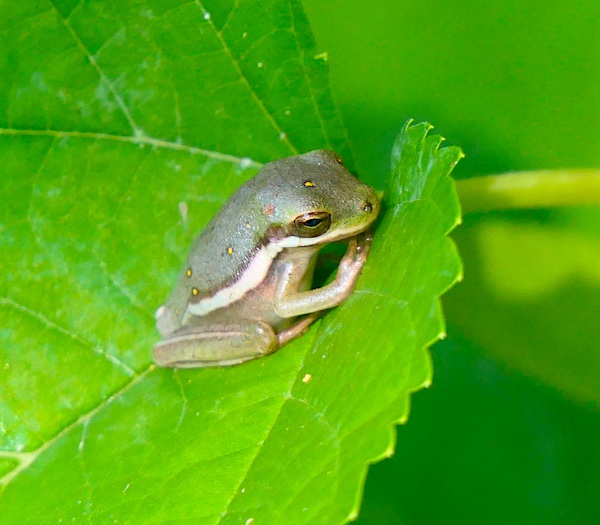
Is this froglet an axanthic green tree frog, or have the frog’s chromatophores (color-producing cells below the epidermis) simply not kicked in yet.
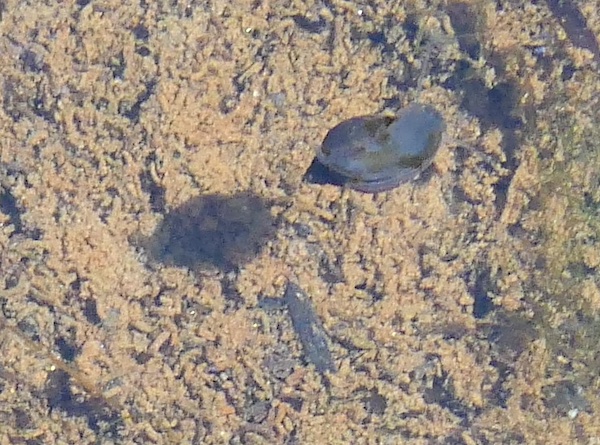
Looking down at the water from the Explore the Wild boardwalk at the vegetation growing below I could see shiny, round or ovate objects on the plants and muddy bottom of the pond. A look through my binoculars revealed what looked to be snails.
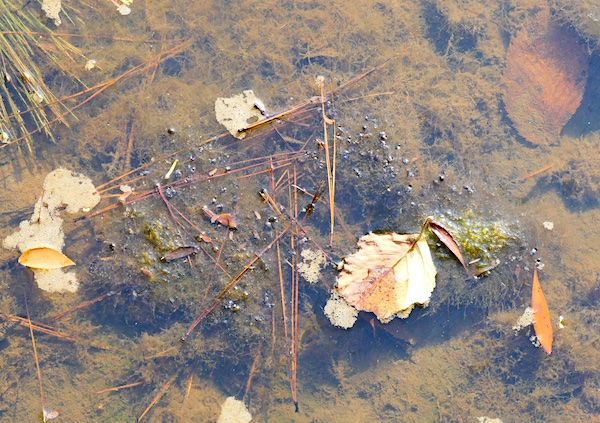
I had written about this same type of snail in the fall of 2023 (once there, scroll down to the snail section).
The snails shown here are air-breathing and must surface to resupply their oxygen which they store in a special bladder just for that purpose.
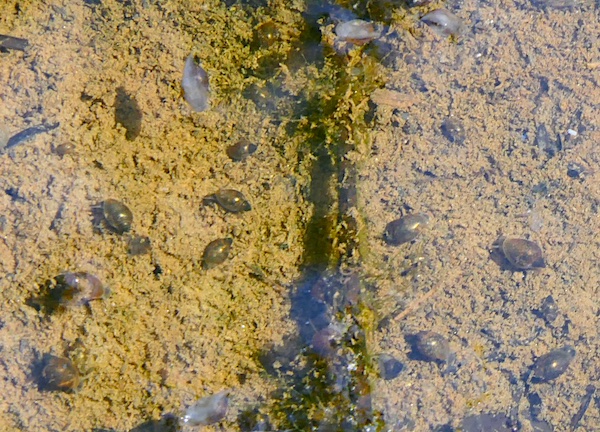
They replenish their air supply by floating upside down on the water’s surface or crawling up on a stem or other object.
At about one half inch long with wings folded over its back an ailanthus webworm moth blends into its surroundings. This, despite the fact that it’s bright orange, white and black. The one in the photo is extracting nectar from the small white flowers of boneset.
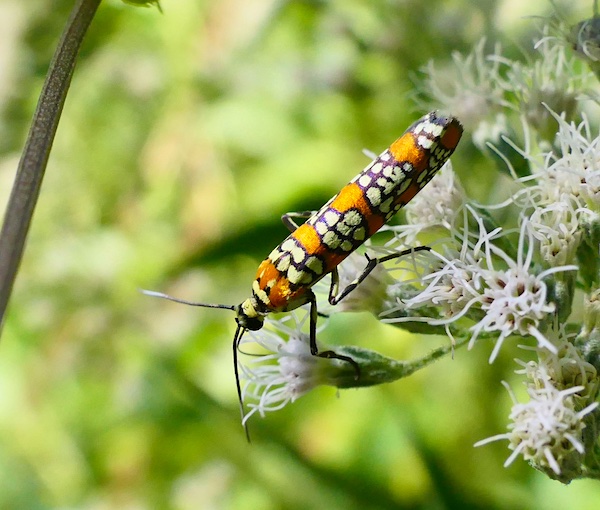
Ailanthus webworms are common in the eastern states and into the southwest. Their wide range has much to do with their now North American host plant, ailanthus, commonly called tree-of-heaven, a fast growing, non-native invasive tree. Tree-of-heaven has spread rapidly across the country after being introduced as an ornamental in 1794 in Philadelphia as well as in the 1800s in New York and California.
The webworm had previously been restricted to tropical areas of the Americas including South Florida as its original host plant was and is the related tropical paradise trees which grow naturally in South Florida. With the fast propagating and growing tree-of-heaven spreading across the land the webworm went along for the ride, so to speak.
Small things are easily overlooked. But keep an eye out, you never know what you’ll discover. There’s always something going on in nature.
Ranger Greg